Course Overview
Singapore’s position as a global financial hub brings opportunity and scrutiny in equal measure. This AML/CFT training course is designed to equip professionals with a clear, practical understanding of Singapore’s regulatory expectations and the skills required to meet them confidently.
Aligned with the requirements and guidance issued by the Monetary Authority of Singapore (MAS), this course focuses on real-world application, risk-based decision-making, and regulatory best practice across banking, fintech, capital markets, and designated non-financial businesses.
Course Goals
By the end of this course, participants will be able to:
-
Understand Singapore’s AML/CFT legal and regulatory framework and their institutional obligations
-
Identify money laundering and terrorism financing risks specific to Singapore’s financial ecosystem
-
Apply a risk-based approach to Customer Due Diligence (CDD) in line with MAS expectations
-
Conduct effective transaction monitoring and prepare high-quality Suspicious Transaction Reports (STRs)
-
Maintain accurate records in compliance with Singapore’s data retention and audit requirements
-
Recognise how technology and automation enhance AML/CFT controls and regulatory effectiveness
What You Will Learn
This course delivers a structured and practical understanding of AML/CFT compliance in Singapore, including:
-
Singapore AML/CFT laws, regulations, and MAS Notices
-
Risk assessment methodologies and red-flag indicators
-
Customer onboarding, CDD, and Enhanced Due Diligence (EDD)
-
Ongoing monitoring and detection of suspicious activities
-
STR filing obligations, timelines, and legal protections for reporters
-
Record-keeping standards and regulatory inspections readiness
-
The role of RegTech, automation, and data analytics in AML compliance
Learning Outcomes
Upon successful completion of this AML/CFT training, participants will be able to:
-
Interpret and apply Singapore AML/CFT laws, regulations, and MAS Notices within their operational roles
-
Conduct risk-based Customer Due Diligence (CDD) and Enhanced Due Diligence (EDD) in line with Monetary Authority of Singapore (MAS) expectations
-
Identify and assess money laundering and terrorism financing risks across products, customers, and transactions
-
Perform effective transaction monitoring and escalate suspicious activity appropriately
-
Prepare and submit accurate and timely Suspicious Transaction Reports (STRs)
-
Maintain compliant record-keeping and data retention practices for regulatory review
-
Understand the role of technology, automation, and RegTech in strengthening AML/CFT controls
In short, participants leave knowing what to do, how to do it, and how not to embarrass their firm during an inspection.
Assessment Format
To ensure practical understanding and regulatory relevance, the course assessment includes:
-
Knowledge Checks
Scenario-based multiple-choice questions testing understanding of Singapore AML/CFT obligations
-
Practical Case Scenarios
Realistic AML risk and transaction monitoring scenarios reflecting Singapore’s financial environment
-
Final Assessment
A structured online assessment requiring participants to demonstrate applied AML/CFT competence
Participants must achieve a minimum pass score to successfully complete the course. Assessments are designed to reflect real compliance decision-making rather than theoretical box-ticking.
Certification
Participants who successfully complete the course and assessment will receive a:
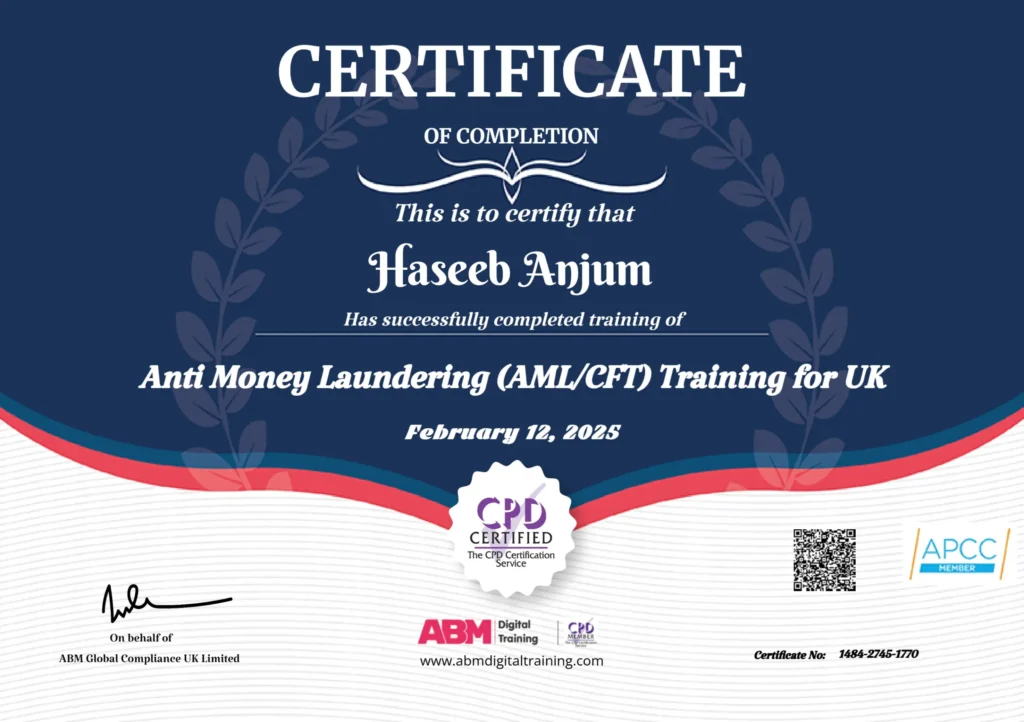
Certificate of Completion – AML/CFT Training (Singapore)
This certification:
-
Confirms training aligned with Singapore AML/CFT regulatory expectations
-
Supports staff competence and ongoing training requirements for MAS-regulated firms
-
Is suitable for banks, fintech's, capital market intermediaries, payment institutions, and DNFBPs
-
Can be used as evidence of AML/CFT training during internal audits and regulatory reviews
Certificates are issued by ABM Digital Training, part of the ABM Global Compliance, with extensive experience delivering compliance and regulatory training across global financial markets.