Need Help?
The AML/CFT Training for South Africa course provides financial professionals, compliance officers, and regulated businesses with a comprehensive understanding of Anti-Money Laundering (AML) and Combating the Financing of Terrorism (CFT) requirements within the South African regulatory framework.
South Africa’s financial sector operates under strict compliance obligations designed to prevent financial crime and maintain transparency within the financial system. This course explains the key legal frameworks, regulatory authorities, and compliance responsibilities that organisations must follow to prevent money laundering and terrorist financing.
Participants will gain practical knowledge of the Financial Intelligence Centre Act (FICA) requirements, including risk-based compliance frameworks, customer due diligence procedures, suspicious transaction reporting, and internal AML controls.
Through real-world examples and practical guidance, the course equips learners with the skills needed to identify financial crime risks, maintain regulatory compliance, and strengthen internal AML/CFT systems within their organisations.
This training programme is designed to address the unique regulatory environment and compliance expectations in South Africa’s financial sector.
The course aims to:
Ensure understanding of South African AML/CFT regulations, including obligations under the Financial Intelligence Centre Act (FICA).
Provide participants with the knowledge and tools required to identify, assess, and mitigate money laundering and terrorist financing risks.
Train professionals to detect suspicious activities and transactions, report them correctly, and support investigations into financial crime.
Equip participants with practical guidance on building and managing AML/CFT compliance programmes, including internal controls, policies, and monitoring procedures.
Promote a culture of compliance, vigilance, and ethical responsibility across financial institutions and regulated entities.
After completing this course, participants will achieve the following outcomes:
Develop a solid understanding of AML/CFT concepts, South African regulatory requirements, and financial crime risks.
Strengthen the ability to implement AML compliance procedures and regulatory reporting obligations.
Learn how to identify, assess, and manage financial crime risks using a risk-based compliance approach.
Gain the ability to recognise suspicious activities and fulfil reporting obligations under South African regulations.
Promote strong ethical standards and professional conduct in financial crime prevention.
The AML/CFT Training for South Africa course provides a comprehensive overview of the principles and regulatory framework governing anti-money laundering and counter-terrorist financing compliance within South Africa.
Participants will explore the structure of the South African financial system, including the role of key supervisory and regulatory authorities responsible for enforcing AML/CFT requirements.
The course focuses on practical compliance measures such as customer due diligence (CDD), suspicious activity reporting, sanctions screening, and risk-based compliance programmes. Learners will also examine emerging financial crime threats and global AML/CFT initiatives to better understand the evolving compliance landscape.
By completing this course, participants will be able to detect suspicious financial activity, implement effective AML/CFT controls, and ensure compliance with South African regulatory requirements while supporting the integrity of the financial system.
Definition and examples of money laundering
Money laundering techniques and stages
Definition of terrorist financing
Identifying characteristics and methods of terrorist financing
Importance and objectives of AML and CFT
Overview of the South African economy and banking sector
Global AML/CFT policies and international standards
Overview of key AML/CFT legislation in South Africa
Financial Intelligence Centre Act (FICA) requirements
Role of regulatory authorities
Reporting obligations and regulatory expectations
Penalties for non-compliance
Know Your Customer (KYC) procedures
Enhanced Due Diligence (EDD) for high-risk customers
Customer risk assessment and profiling
Identifying suspicious transactions
Filing Suspicious Activity Reports
Confidentiality and whistle-blower protection
Developing an AML/CFT compliance framework
Internal controls and governance
Ongoing monitoring and auditing procedures
Understanding sanctions lists and screening requirements
Compliance with international sanctions
Global cooperation in combating financial crime
New and emerging financial crime threats
Industry-specific AML best practices
Technology and innovation in AML compliance
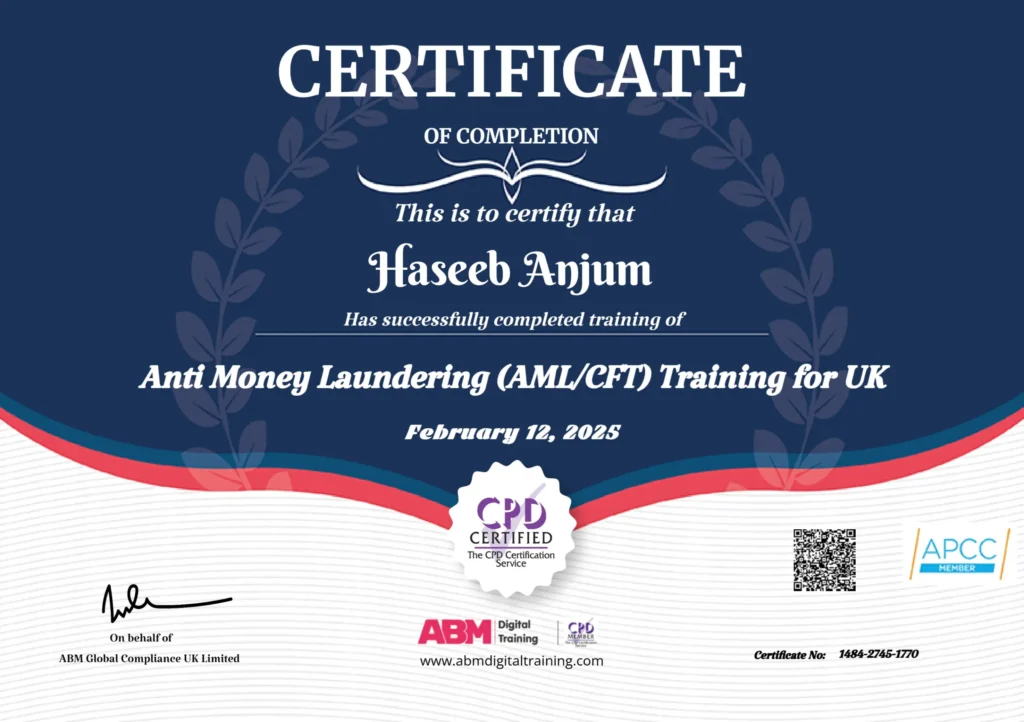
Participants who successfully complete the course will receive an AML/CFT Training Certificate for South Africa, demonstrating their understanding of AML compliance requirements and financial crime prevention practices.
This module introduces learners to the fundamental concepts of money laundering (ML) and terrorist financing (TF), explaining how illicit funds are generated, moved, and disguised within the financial system. Participants will gain an understanding of the risks these activities pose to financial institutions, economies, and global security.
The module explores the three key stages of money laundering: placement, layering, and integration. Learners will also examine the differences between money laundering and terrorist financing, including how funds are sourced and ultimately used.
Anti-money laundering (AML) regulations are essential in combating financial crime and maintaining the financial system's integrity. By implementing robust AML policies and procedures, governments and financial institutions can detect and deter criminal activities such as drug trafficking, terrorism financing, and tax evasion. Effective AML regulations protect the reputation and stability of financial institutions and contribute to society's overall safety and security.
The first significant step towards establishing a robust AML framework in South Africa was the enactment of the Prevention of Organised Crime Act (POCA) in 1998. POCA provided a legal foundation for confiscating proceeds from unlawful activities and established reporting obligations for financial institutions regarding suspicious transactions.
South Africa's regulatory authorities, including the FIC, SARB, and FSCA, issue guidelines and directives to provide practical guidance to financial institutions and accountable institutions on AML/CFT compliance. These guidelines help entities understand their obligations and best practices for AML/CFT measures.
Regulatory authorities play a vital role in the oversight and enforcement of anti-money laundering (AML) and combating the financing of terrorism (CFT) regulations.
In this module, we'll explore the essential concepts of CDD, including KYC procedures, EDD for high-risk customers, and customer risk assessment and profiling.
Welcome to Module 6, where we will concentrate on identifying and reporting suspicious transactions, an essential part of preserving the integrity of the financial system. In this session, we'll talk about the value of being vigilant, warning signs to look out for, how to report problems, and how to overcome obstacles.
Financial institutions and companies must create and implement an anti-money laundering (AML) and countering the financing of terrorism (CFT) compliance programme to ensure that their services are not utilised for illegal purposes like money laundering and terrorist funding.
Global measures to combat financial crimes and the funding of terrorism must include sanctions and international cooperation in AML/CFT (anti-money laundering and countering the financing of terrorism). It is critical to comprehend sanctions lists and their ramifications in the context of AML/CFT.
As criminals and other illicit actors adjust to shifting conditions and take advantage of flaws in the financial system, new threats and trends in anti-money laundering (AML) and countering the financing of terrorism (CFT) are constantly emerging. For AML/CFT initiatives to be successful, it is essential to stay on top of these trends. The following are some new dangers and trends in AML/CFT

AML/CFT Training course is certified by The CPD Certification Service.

Thousands of professionals trust ABM Digital Training for their AML and compliance education. Our commitment to quality, accessibility, and practical learning sets us apart. We deliver online programmes combining regulatory expertise with engaging content to ensure you gain knowledge that makes a measurable difference in your compliance role.
Validate your expertise with recognised professional certification.
We’re here to assist you every step of the way. Reach out to us anytime!
Access our complete AML course library trusted by professionals worldwide. Each programme features interactive modules, real-world case studies, and assessments to validate your knowledge, boost credentials, and strengthen your expertise in financial crime prevention.