
Need Help?
Canada–and more specifically financial centres such as Toronto, Montreal, and Vancouver–is known to be a haven for illicit financial activity. Despite Canada’s ongoing regulation, and businesses’ efforts to comply, combatting money laundering remains a challenge as Canadians tend to be very trusting and often give the benefit of the doubt to business partners. To tackle this on-going issue, this training course will teach you all about how to identify and report these criminal activities such as money laundering and terrorist financing to legal Canadian authorities.
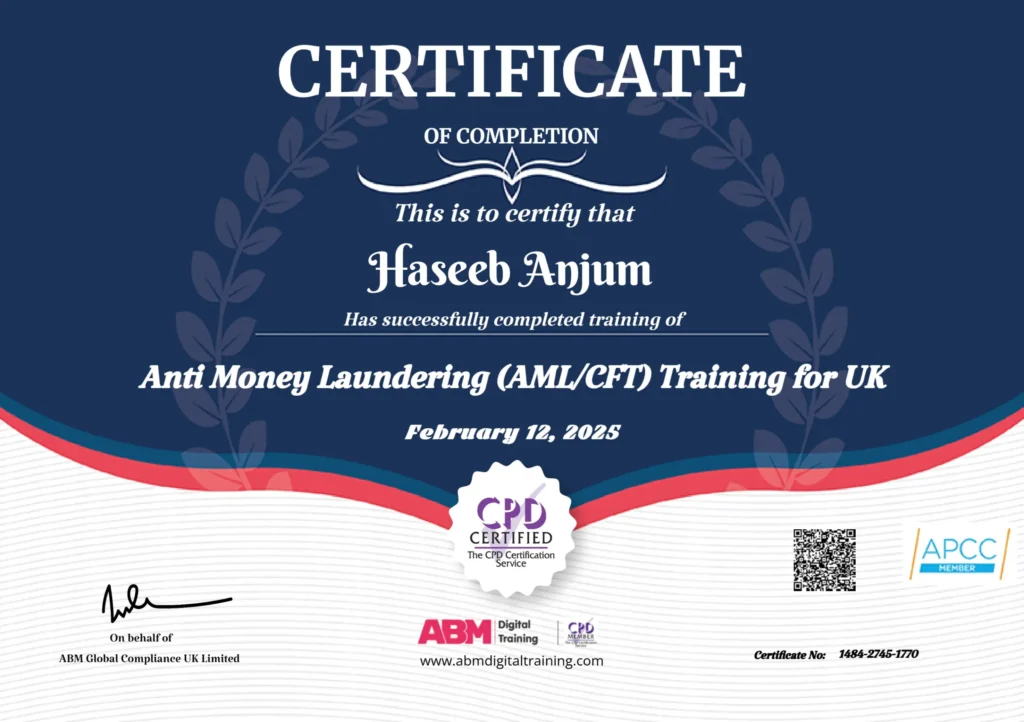
This course will also help you learn about the entire process of how criminals hide their illegal sources and involve in fraudulent activities with customers, making it difficult to track these sources and customers lose all of their trust in financial authorities. You will also explore and practice this training by completing quizzes relevant to each topic and once you clear the quiz, you will hold a certification from one of the recognized financial services firms in the UK that holds significant value for your career and profession. In this anti-money laundering training in Canada, we will touch on 9 important topics.
Canada’s anti money laundering framework was introduced in October of 2014 and is one of the most comprehensive in the world. The framework aims to protect Canadian citizens from financial crimes and terrorist financing by setting out rules and regulations that banks, financial institutions, and other regulated entities must follow. The framework includes requirements for identifying and monitoring suspicious activity, implementing anti-money laundering compliance programs, reporting suspicious activities to law enforcement, and maintaining records of transactions.
In Canada, the key elements of AML training typically include an overview of the country’s AML legislation and regulations and guidance on identifying and reporting suspicious transactions. anti money laundering training may also cover topics such as money laundering typologies, red flags, and best practices for compliance with AML requirements.
There are many reasons to choose us for your anti-money laundering training in Canada. Here are some of the most important ones:
The AML training Canada is a comprehensive and multi-faceted program that helps organizations to protect themselves from money laundering and terrorist financing. The program is online and covers identifying and reporting suspicious transactions, understanding customer due diligence requirements, and implementing effective AML compliance policies and procedures.
There are many benefits to AML training in Canada. One of the most important benefits is that it helps to protect the Canadian economy from money laundering and terrorist financing. In addition, AML training helps to ensure that financial institutions and other businesses are complying with Canadian anti-money laundering laws and regulations. AML training also helps to build public trust in the Canadian financial system.
In Canada, any individual or organization that is involved in the business of dealing in securities or providing investment advice must complete anti-money laundering (AML) training. This includes all employees of banks, investment dealers, and mutual fund dealers, as well as all individuals or organizations registered as securities advisers, futures commission merchants, or commodity trading advisors.
There is no definitive answer to this question. Depending on your personal circumstances and goals, the best time to take AML training may vary. However, some factors to consider include your work schedule, family commitments, and the availability of courses. Many financial institutions offer AML training, so it is important to research different options to find the best fit for you.
The cost of anti-money laundering (AML) training in Canada is £150.
All Canadian accountants must report to FINTRAC all Suspicious Transaction Report (STR) or Suspicious Activity Report (SAR) without any delay.
This module will help identify and explain two options for electronic suspicious reporting that provide for secure encrypted transmission that ensures your data's confidentiality and integrity.
You will also learn about how to compare the client‘s transaction history to the client‘s specific profile information to identify any anomalies or suspicious activity.
All Canadian accountants must report to FINTRAC all Suspicious Transaction Report (STR) or Suspicious Activity Report (SAR) without any delay.
This module will help identify and explain two options for electronic suspicious reporting that provide for secure encrypted transmission that ensures your data's confidentiality and integrity.
You will also learn about how to compare the client‘s transaction history to the client‘s specific profile information to identify any anomalies or suspicious activity.
All Canadian accountants must report to FINTRAC all Suspicious Transaction Report (STR) or Suspicious Activity Report (SAR) without any delay.
This module will help identify and explain two options for electronic suspicious reporting that provide for secure encrypted transmission that ensures your data's confidentiality and integrity.
You will also learn about how to compare the client‘s transaction history to the client‘s specific profile information to identify any anomalies or suspicious activity.
This chapter will talk about how to send a large cash transaction Large Virtual Currency Transaction report to FINTRAC.
FINTRAC will send you an acknowledgement message when your large cash transaction report has been received electronically.
You will also gain knowledge on what Virtual currency is and what are the requirements associated to large virtual currency transactions
This chapter will talk about how to send a large cash transaction Large Virtual Currency Transaction report to FINTRAC.
FINTRAC will send you an acknowledgement message when your large cash transaction report has been received electronically.
You will also gain knowledge on what Virtual currency is and what are the requirements associated to large virtual currency transactions.